
Today, we’re excited to announce our collaboration with Google Cloud.
As organizations build more of their infrastructure in the cloud, secrets become an increasingly important part of how applications, services, and workloads communicate. Those secrets also end up in more places than security teams can easily track. A Google Cloud service account key might be committed to a repository, pasted into Slack during troubleshooting, included in a support ticket, or left in cloud storage.
When one is exposed, finding it answers only the first question. Security teams still have to determine whether the secret is active, identify the non-human identity behind it, understand what that identity can access, find the right owner, and make sure the secret is actually revoked. Without that context, every finding can turn into its own investigation, slowing remediation while developers and security teams piece together information from different systems.
Our collaboration with Google Cloud helps bring those pieces together.
From exposed secret to actionable context
TruffleHog Enterprise scans across the places secrets can surface, including repositories, chat systems, support tickets, and cloud storage. When it finds a secret, it verifies it directly with the provider, helping teams separate active exposures from false positives before spending time investigating them.
But knowing a Google Cloud secret is active still doesn’t tell you what the exposure means. A secret with narrow access presents a very different situation from one connected to a service account with permissions across sensitive resources. Without visibility into that access, teams may have an active secret in front of them but still lack the information needed to understand its potential impact.
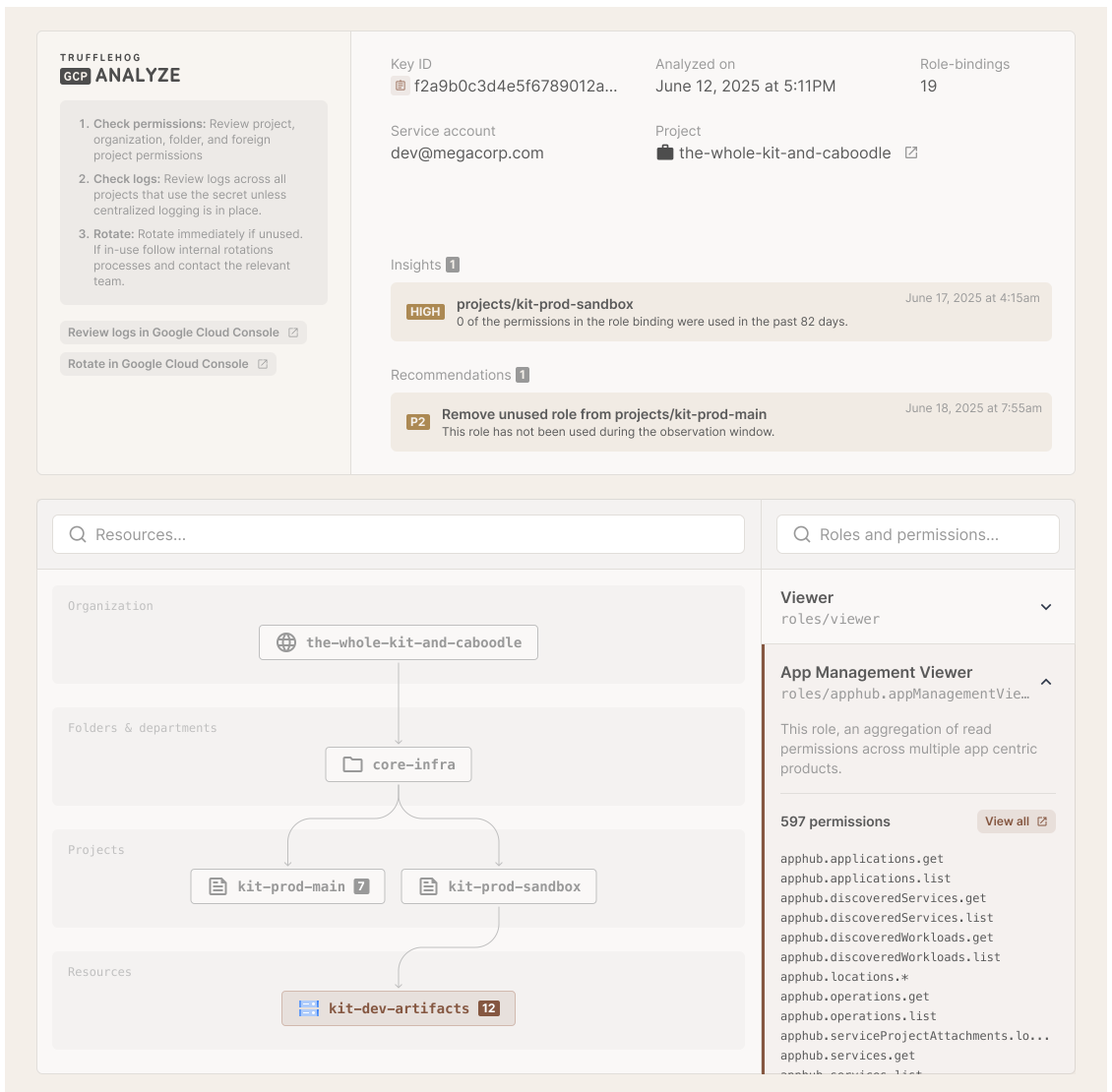
For Google Cloud secrets, the Truffle GCP Analyze solution connects the exposed secret to the non-human identity behind it and maps its permissions and resources. Teams can see hierarchical access paths, project permissions, and resource exposure, providing the context they need to understand blast radius and decide how urgently an exposure needs to be addressed.
Making remediation easier
Understanding the exposure is only useful if teams can act on it. Secret remediation often crosses organizational boundaries: security finds the exposure, but a developer or service owner may be responsible for rotating the secret. If ownership, access, and rotation information have to be investigated separately, the finding can sit unresolved while teams determine what to do and who needs to do it.
TruffleHog Enterprise brings that context into the remediation workflow, including guidance to help the responsible team rotate the secret. After rotation, TruffleHog Enterprise re-verifies the secret to confirm revocation, so security teams can verify that the underlying exposure was addressed rather than relying on a closed ticket as evidence of remediation.
Truffle Security: A clearer view of secret risk
Cloud environments are making the gap between finding a secret and understanding the risk behind it increasingly important. Security teams need visibility across the places secrets can leak, but they also need enough context to turn those findings into action.
Our collaboration with Google Cloud helps close that gap by connecting secrets detection and verification with the identity and access context teams need to investigate and remediate exposed secrets.


